Start Your Project
Have a project in mind?
Schedule an introductory consultation to discuss your vision, timeline, and project requirements.
Explore what defines thoughtful interior design in Manhattan — from working with existing architecture and city views to choosing materials, integrating technology and creating spaces that support everyday life. Discover why the best interiors are shaped not by trends, but by careful decisions, proportion and a deeper understanding of how people live.
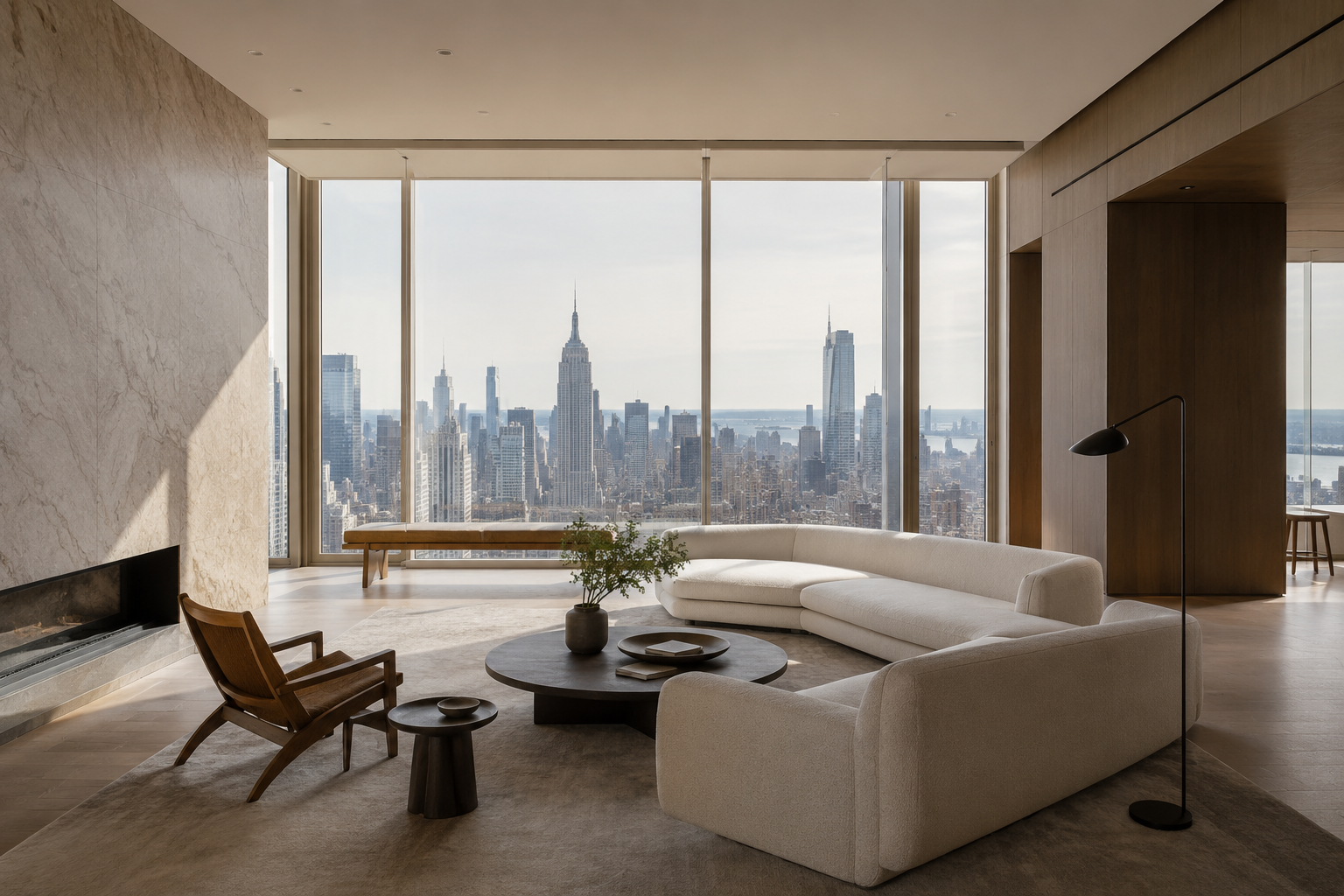
Manhattan is not an easy place to design for. Space is valuable, buildings have their own histories, views can define an entire apartment, and the architecture of a home is often inseparable from the character of the city outside it. A pre-war apartment, a townhouse and a newly built penthouse may all require completely different design decisions.
This is why choosing an interior design studio in Manhattan is not simply about finding a studio whose portfolio you like. The more important question is how the studio thinks. How does it read an existing space? What does it preserve? What does it change? How does it decide where to spend attention — and where to leave things quiet?
At AISA Interior Atelier, we believe these questions are where good interior design begins.
Luxury is easy to recognise, but much harder to define. A room can contain beautiful stone, expensive furniture and carefully selected finishes and still feel uncomfortable. It may photograph well but fail to work in everyday life. This happens when individual elements are considered separately from the space as a whole.
In our experience, the strongest interiors usually come from a different process. Before thinking about materials or furniture, we look at proportion, movement, light and relationships between rooms.
- Why does one room feel generous while another feels compressed?
- Where does the eye naturally move when you enter?
- Which spaces should connect, and which should remain private?
- Where does the architecture already have character, and where does it need to be rethought?
These questions may not be visible in the final photographs, but they often determine whether the finished interior feels genuinely resolved.
One of the interesting things about working in New York is that the building often gives you the first part of the design brief. A pre-war apartment may have generous ceiling heights, deep window reveals, decorative details or an established rhythm of rooms. A contemporary tower may offer expansive glazing, open floor plates and panoramic views.
It would make little sense to approach both in exactly the same way. The temptation during a renovation is to erase everything and start again. But removing all traces of the original architecture does not necessarily create a better interior.
Sometimes the more intelligent decision is to identify what is worth keeping. An old doorway may establish the proportions of a room. A particular window position may determine the furniture layout. Existing millwork may be restored rather than replaced. Good renovation is often less about starting from zero and more about understanding what is already there.
This is a simple question, but it can change an entire plan. In a Manhattan apartment, the first view from the entrance may lead towards a window, a work of art, a fireplace or a carefully framed architectural feature.
That first sightline creates an expectation of what the home will feel like. From there, we think about the sequence of spaces.
- What should be revealed immediately?
- What should be discovered gradually?
- Where should the view become the focus?
- Where should the architecture become quieter?
This is particularly important in apartments with exceptional views. It is tempting to orient everything towards the skyline, but doing so can make the interior feel visually flat. A home still needs moments of intimacy. The city should be present, but it should not dominate every room.
New York gives residential interiors something that few cities can offer: constantly changing visual depth. The skyline changes with weather, season and time of day. Sunlight moves across neighbouring buildings. A river can disappear into the evening haze. At night, the city becomes an entirely different composition.
An interior should allow these changes to be experienced. This affects the choice of colours and materials, but also the way furniture is positioned and how artificial lighting is introduced.
For example, a highly reflective material may look impressive during the day but create unnecessary visual noise at night. A darker surface can sometimes make a view feel more luminous because it provides contrast. This is why material selection cannot be separated from context. The same stone, colour or finish can behave completely differently depending on the light around it.
There is a common assumption that a luxury interior needs to make an immediate impression. We often find the opposite. The more sophisticated the space, the more carefully its visual noise tends to be controlled.
This does not mean minimalism for its own sake. It means deciding which elements deserve attention.
- If every wall has a feature, no feature remains special.
- If every piece of furniture is sculptural, the room becomes a collection rather than a composition.
- If every material has a strong texture, there is nowhere for the eye to rest.
The work is therefore partly about editing. Removing the unnecessary can require more thought than adding something new.
Material choices are often discussed in terms of style: marble for luxury, wood for warmth, metal for sophistication. But materials can do much more than establish an aesthetic. They can change how a room is perceived.
A continuous stone surface can visually connect separate areas. Timber can soften a large architectural volume. Plaster can absorb light and create a quieter background. Bronze can introduce warmth without adding colour in the conventional sense.
The question is not simply, “Does this material look beautiful?”
It is also:
- What does this material do to the space?
- How does it respond to daylight?
- How does it feel when touched?
- How will it age?
- Does it reinforce the architecture or compete with it?
These considerations become particularly important in luxury residential design because the materials are expected to remain part of the home for many years.
An interior can look convincing at the concept stage and still lose its quality during construction. This is where detailing becomes important. The alignment of doors and panels. The depth of a reveal. The junction between stone and timber. The way a light source disappears into a ceiling. The proportions of a kitchen island.
Individually, these details may seem insignificant. Together, they determine whether a space feels calm or slightly unsettled. This is why we see custom joinery not simply as furniture, but as part of the architecture.
- A wardrobe can become a wall.
- A library can define a room.
- A kitchen can disappear into the architectural background when it is not in use.
The goal is not to show how much has been customised. It is to make the custom work feel inevitable.
The most beautiful room is not necessarily the most successful room. A home has to accommodate real life. There are mornings when the apartment is quiet, days when someone is working from home, evenings when friends arrive unexpectedly and weekends when several people use the same space in completely different ways.
These patterns influence planning more than any trend.
- A dining room may need to function as a formal setting for twelve people but also feel comfortable for two.
- A living room may need to support conversation without becoming centred around a television.
- A bedroom may require stronger acoustic separation than its floor plan initially suggests.
- Storage needs to be generous without becoming visually dominant.
These are not decorative decisions. They are architectural ones.
Modern Manhattan residences often contain complex systems: lighting controls, climate management, audio, security, automated shades and integrated appliances. Yet the more technology a home contains, the less visible it should ideally become.
This creates an interesting design problem. How do you introduce sophisticated systems without making the interior feel technical?
The answer often lies in integration. Controls can disappear into joinery. Speakers can be concealed. Lighting can be layered rather than exposed. Mechanical systems can be coordinated early enough to avoid compromising ceiling proportions. Technology should make a home more comfortable without becoming the subject of the room.
New York has an incredibly strong design identity, but that does not mean every Manhattan interior needs to look unmistakably “New York”. Working across different countries and architectural traditions can be useful precisely because it prevents a project from becoming too predictable.
European interiors often bring a particular sensitivity to proportion and materiality. Contemporary Asian architecture can offer lessons in restraint and transitions between spaces. Other cultures approach privacy, hospitality and the relationship between inside and outside very differently. These influences can inform a project without being copied. The goal is not to create a recognisable international style. It is to have a larger vocabulary from which to make the right decision for one particular home.
Perhaps the better question is not which interior design studio in Manhattan has the most impressive portfolio. It is which studio is capable of asking the right questions before the design begins.
- What is valuable about this building?
- What should remain?
- What is missing?
- Where should the budget make the greatest difference?
- What will still feel relevant in ten years?
- And how can the interior become more personal without becoming visually complicated?
The answers are different for every project. That is precisely why a strong design process cannot be reduced to a signature look.
For us, luxury is not about how much a room contains. It is about how naturally everything works together.
- The right light at the right time.
- A material that feels better as it ages.
- A piece of joinery that solves a practical problem without drawing attention to itself.
- A view that has been given enough space to be appreciated.
- A room that feels equally comfortable when it is empty and when it is full of people.
These are small things individually. Together, they create the feeling of a well-designed home.
The best Manhattan interiors are rarely the ones that try hardest to impress. They are the ones where the decisions begin to make sense the longer you live with them.
Architecture, light, materials, technology and furniture become part of the same system — designed not only to look considered, but to support the way a home is actually lived in.
At AISA Interior Atelier, this is how we approach interior design in Manhattan: by looking closely at the building, questioning what is necessary and designing every element with a sense of purpose.
Have a project in mind?
Schedule an introductory consultation to discuss your vision, timeline, and project requirements.