Start Your Project
Have a project in mind?
Schedule an introductory consultation to discuss your vision, timeline, and project requirements.
Discover how Palm Jumeirah villa interiors can balance waterfront views, privacy, climate and contemporary design to create elegant homes shaped by their unique Dubai setting.

Designing a villa on Palm Jumeirah begins with something most homes do not have: an unusually strong relationship with the water. The sea is visible from living rooms, bedrooms, terraces and gardens, and in many villas the beach effectively becomes an extension of the property. Yet the same openness that makes these homes exceptional also creates their biggest design challenge.
A successful Palm Jumeirah villa interior has to achieve several things at once. It should frame the view without exposing the entire house, respond intelligently to Dubai’s intense sun and coastal climate, and create a contemporary atmosphere that feels sophisticated without becoming overdesigned.
This is where interior design moves beyond decoration. The real work is in controlling what is seen, how the home responds to daylight, and how private and social spaces coexist within an architecture that naturally wants to remain open.
In waterfront villa design, there is an understandable temptation to orient everything towards the sea. Floor-to-ceiling glazing, large open-plan living spaces and uninterrupted sightlines can make an immediate impression, but a good interior needs more hierarchy than a single panoramic gesture.
On Palm Jumeirah, the most successful layouts treat the view almost as an architectural material. Certain rooms open completely towards the water, while others reveal it more selectively through framed perspectives, courtyards, screens or changes in level. This creates a sequence of experiences rather than exposing the entire villa at once.
The principal living room may be organised around the horizon, while a dining area feels slightly more enclosed. A staircase can catch a controlled glimpse of the sea. A master bedroom may have a panoramic outlook from the bed while its dressing room and bathroom remain deliberately protected.
This balance makes the landscape feel more powerful because it is not repeated in exactly the same way from every room. Palm Jumeirah’s Fronds are characterised by private villa communities with direct beach access and a stronger degree of residential seclusion, making this relationship between architecture, coastline and privacy particularly important.
Privacy on Palm Jumeirah is more complex than simply closing curtains. Many waterfront villas combine expansive glazing with neighbouring residences positioned relatively close along the shoreline. At the same time, owners often want gardens, pools, terraces and main living spaces to remain visually connected. The challenge is therefore to protect the interior without losing the openness that makes the property valuable in the first place.
This can be achieved through several layers of design:
The best solutions are barely noticeable. Privacy becomes part of the architecture rather than something added afterwards.
This is especially relevant in contemporary luxury interiors, where large areas of glass are common. Recent premium waterfront projects on Palm Jumeirah similarly place significant emphasis on combining panoramic views with privacy rather than treating the two as opposing ideas.
A Palm Jumeirah villa can appear extremely light and transparent in photographs, but designing for everyday life requires considerably more control. Dubai’s sun affects how glazing, furniture, natural stone, timber and fabrics behave throughout the day. West- and south-west-facing areas can receive particularly strong solar exposure, which is why façade orientation, shading and glass performance have to be considered together with the interior concept. Dubai Municipality guidance specifically addresses solar heat gain and recommends external shading where large openings occur on highly exposed orientations.
For an interior designer, this changes the conversation around luxury. Comfort cannot depend entirely on air conditioning or permanently closed curtains.
Deep terraces, recessed glazing, exterior shading, layered window treatments and thoughtful zoning can dramatically improve the way a villa feels during the hottest parts of the day. Materials should also be selected not only for appearance but for how they react to strong daylight over time.
A beautiful material that requires constant protection from the environment is rarely the most sophisticated choice for a waterfront home.
A Palm Jumeirah interior does not need seashell motifs, obvious blue accents or a conventional “beach house” palette to communicate its location.
Contemporary waterfront interiors tend to work better when the connection to the coast is expressed through atmosphere: tactile stone, pale or smoked timber, brushed metals, textured plaster, linen, carefully selected textiles and materials that respond beautifully to changing daylight.
The palette can remain restrained while still having character. The important part is variation in texture, scale and reflectivity.
Highly polished surfaces everywhere can make a villa feel closer to a hotel lobby than a private home. Conversely, an entirely beige interior often loses definition against Dubai’s already bright exterior environment. Stronger moments — artwork, sculptural furniture, darker timber, coloured stone or a distinctive object — can provide the visual tension needed to give the rooms identity. The objective is not minimalism for its own sake. It is precision.

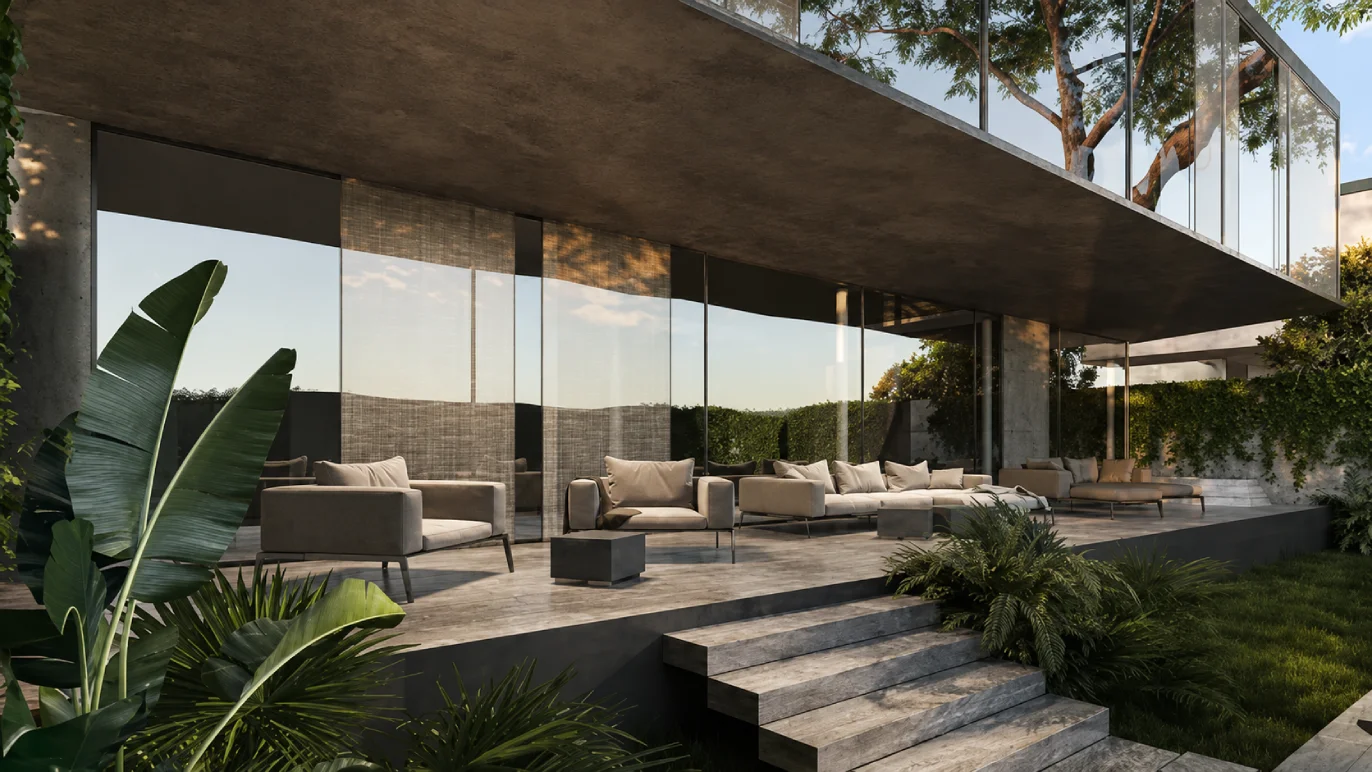
One of the most valuable qualities of a Palm Jumeirah villa is the transition from interior to terrace, pool, garden and beach.
That transition should therefore be considered from the earliest stages of interior planning. When viewed from the living room, outdoor furniture, planting, pool edges, architectural lighting and even the position of a tree become part of the interior composition.
Floor finishes do not necessarily need to be identical inside and outside, but their scale and tone should communicate with one another. Furniture layouts should correspond with the exterior rather than turning away from it. Lighting should maintain depth after sunset instead of leaving the glass walls reflecting a brightly illuminated interior back at the occupants.
This is particularly important in Dubai, where a villa changes character dramatically between daytime and evening. During the day, the sea and sky dominate. After dark, the interior, landscape and architectural lighting have to create the atmosphere themselves.
There was a period when high-end villa interiors in Dubai were often defined by visible abundance: rare stone, decorative lighting, dramatic ceilings and highly recognisable furniture pieces. Contemporary clients increasingly expect something different.
The strongest Palm Jumeirah homes still use exceptional materials and bespoke elements, but their value is often expressed more quietly — through proportion, joinery, lighting, acoustic comfort, integrated technology and the way the plan supports everyday routines.
A concealed service kitchen may matter more than another decorative wall. A well-designed entrance sequence can create more impact than an oversized chandelier. Storage integrated seamlessly into architecture can make a bedroom feel considerably calmer. Lighting that changes naturally from daytime to evening can transform how every material in the house is perceived.
Contemporary luxury is therefore less about how much is added and more about how carefully everything is resolved.
The defining feature of Palm Jumeirah villa interior design is not a particular aesthetic. It is the need to work intelligently with a very specific environment.
Water should be present without dominating every room. Views should feel generous without compromising privacy. Daylight should animate materials without making the interior uncomfortable. Outdoor spaces should belong to the architectural composition rather than functioning as a separate landscape project.
When these elements are considered together, the result is a home that feels distinctly connected to Palm Jumeirah while remaining personal to its owners.
Have a project in mind?
Schedule an introductory consultation to discuss your vision, timeline, and project requirements.